

Why Do We Need Novel Protein Sources?
With the global population projected to reach approximately 9.7 billion by 2050, ensuring a sustainable supply of protein has become a strategic priority for the food industry. Reliance on industrial livestock production is associated with high water and land use, as well as a significant contribution to greenhouse gas emissions. At the same time, the growing elderly population has substantially increased the demand for high-quality protein, with recommended intake levels for certain age groups rising to nearly double those of young adults. Under these circumstances, developing alternative protein sources that are both sustainable and nutritionally valuable has become a necessity in food research and development. Fungal protein, commonly known as mycoprotein, offers an innovative solution with the potential to simultaneously address food security, environmental sustainability, and the nutritional needs of the future.
What Is Fungal Protein?
Fungal protein is derived from the biomass of filamentous fungi, primarily produced from the species Fusarium venenatum and after a controlled fermentation process, serves as a rich source of both protein and fiber. The development of this technology involved over 20 years of research and development and was brought to commercial scale under the scientific guidance of experts such as Tim Finnigan at Marlow Foods.
This innovation traces its roots back to the efforts of the “Green Revolution” in the UK, where screening more than 3,000 soil microorganisms led to the discovery of a strain, capable of consuming carbohydrates like starch and producing high-value protein. The production process involves continuous fermentation, nucleic acid reduction, steaming, cooling, and freezing, ultimately yielding a product with a fibrous texture. This natural structure provides a significant textural similarity to chicken meat, unlike plant proteins that require extrusion, offering a technological advantage in the development of meat alternative products.
Biotechnology of Fungal Protein Production
Fungal protein is produced by fermenting agricultural and industrial residues through microbial processes. Substrates such as seaweed waste, date residues, malt by-products, soybean waste, pineapple peel, and chickpea processing residues can serve as sources for fungal biomass. Large-scale production typically uses two main fermentation approaches: Solid-State Fermentation (SSF) and Submerged Fermentation (SmF).
Solid-State Fermentation
SSF is a biotechnological method where microorganisms grow on solid substrates with low moisture, without free liquid. Water is present only as a thin layer on solid particles. Advantages include low water use, utilization of agricultural residues, high product concentration, similarity to fungi’s natural habitat, and reduced bacterial contamination.
SSF involves multiple stages which are critical for producing protein-rich biomass. Substrate preparation mixes raw materials to create a nutrient-rich environment and maintain structural integrity. Common ingredients include wheat, barley, oats, and other cereals. Selected fungal strains, usually from the Fusarium genus, are inoculated into the substrate, initiating spore or mycelium growth.
Incubation occurs under controlled conditions in bioreactors, with temperature, humidity, and aeration precisely adjusted to optimize fungi growth and protein synthesis. As biomass increases, fungi metabolize nutrients, producing mycelium and fungal protein. This protein is nutritionally valuable due to its high content of essential amino acids.
At the end of incubation, biomass is extracted from the substrate, separating protein from residual spores. It is dissolved in an organic solvent, filtered, and centrifuged to obtain purified fungal protein. Additional processing enhances sensory properties, nutritional profile and texture. Texturization, flavor improvement, and shaping, simulate meat products, producing a flexible ingredient suitable for diverse food applications. Thermal treatment reduces RNA content to prevent excessive uric acid, and compression and blending with functional ingredients finalize the product.
Submerged Fermentation
In SmF, microorganisms grow in liquid media with abundant water, metabolizing carbon and nitrogen sources under aerobic or semi-anaerobic conditions. SmF is widely used in bioprocessing, although SSF attracts attention for higher efficiency, lower water use, and reduced contamination risk. Microorganisms are cultivated in nutrient-rich media containing carbon, nitrogen, vitamins, minerals, and essential growth factors.
The process starts with cultivating a pure fungal inoculum, which is then added to the fermentation medium. Fermentation occurs in controlled bioreactors, where temperature, pH, oxygen supply, and agitation are precisely regulated. Fungal cells metabolize nutrients, producing protein-rich biomass with high nutritional value. SmF is continuously monitored for biomass concentration, protein yield, pH stability, and oxygen sufficiency. Once protein accumulation reaches the target, fermentation stops, and biomass is separated through centrifugation or filtration. The harvested biomass undergoes further processing to improve texture and sensory quality, yielding a versatile ingredient suitable for meat alternatives.
Specialized Bioreactors for Mycoprotein Production
Submerged fermentation bioreactors often use air-lift technology, differing from conventional stirred tanks. Air-lift systems generate mycelial biomass with low shear stress, supporting long hyphal growth essential for meat-like textures. They require less energy while ensuring effective mixing, as sterile air bubbles provide oxygen and circulation. This design is a major advantage over mechanically stirred bioreactors and supports large-scale industrial applications.

Nutritional and Functional Value of Fungal Protein
The table below illustrates the nutritional characteristics of a representative mycoprotein:
| Nutritional Composition of Mycoprotein per 100 g (wet weight) | Quantity |
| Energy, kcal | 85 |
| Protein, g | 11 |
| Total fat, g | 2.9 |
| Saturated fatty acids, g | 0.7 |
| Monounsaturated fatty acids, g | 0.5 |
| Polyunsaturated fatty acids, g | 1.8 |
| Total carbohydrate, g | 3.0 |
| Sugars, g | 0.5 |
| Dietary fiber, g | 6.0 |
| Vitamin B-12, μg | 0 |
| Sodium, mg | 5.0 |
| Cholesterol, g | 0 |
| Iron, mg | 0.5 |
| Zinc, mg | 9.0 |
| Selenium, μg | 20 |
Mycoprotein contains approximately 50% protein on a dry weight basis and provides all essential amino acids. Essential amino acids account for about 41% of the total protein, a proportion higher than most common plant sources, and its amino acid profile is comparable to that of human muscle protein. Human intervention studies have shown that its consumption leads to a gradual but sustained increase in plasma essential amino acids (EAAs) and branched-chain amino acids (BCAAs), reaching a saturation point at higher doses (60–80 grams). This pattern may be particularly important for supporting muscle protein synthesis, especially in the elderly population.
The cell wall, rich in β-glucans and chitin, provides a key functional advantage. Evidence from clinical trials, including studies conducted at the University of Exeter, indicates that meals containing mycoprotein led to a lower insulin response compared to sources like chicken and, in some cases, are associated with a short-term reduction in energy intake. The insoluble fibrous matrix can contribute to improved lipid profiles and cholesterol reduction by slowing the absorption of glucose and branched-chain amino acids, as well as promoting the production of short-chain fatty acids in the gut.
Industrial Applications in Innovative Product Development
Creating Meat-Like Structures
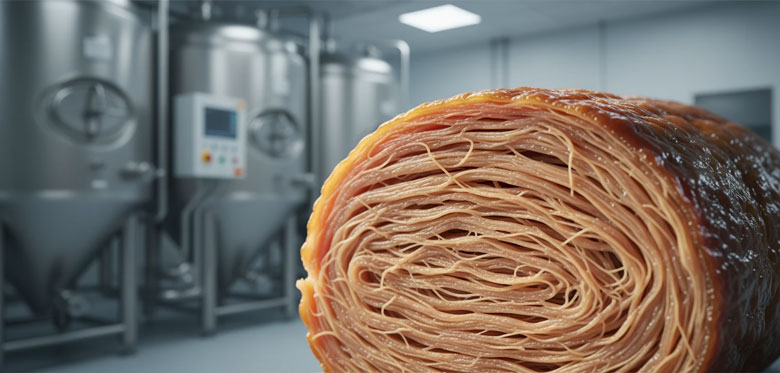
Mycoprotein hyphae, with diameters of 3–5 micrometers and lengths of 400–700 micrometers, exhibit a high length-to-diameter ratio and limited branching, forming a naturally fibrous structure similar to muscle. To achieve a meaty texture, binders such as egg white or plant proteins are incorporated, and the mixture is shaped under pressure. Controlled heating (85–90 °C) followed by gradual freezing compresses ice crystals within the hyphae, forming fibrous bundles that constitute the bulk of the final texture. Thanks to its intrinsic fibrous structure, mycoprotein develops a meat-like texture that is less rubbery and more fibrous compared to typical plant proteins. Texture formation in mycoprotein relies on a fiber–gel composite. The binding gel, particularly egg white gel, plays a key role in developing mechanical and sensory properties. Structural characteristics such as hyphal length-to-diameter ratio, mycelial entanglement, hyphal interactions, and hyphal turgor determine product quality. These features, combined with high water-holding capacity and emulsifying ability, make mycoprotein a scientifically robust and efficient option for formulating meat alternative products, including burgers, nuggets, and plant-based processed foods.
Non-Meat Applications
Mycoproteins are increasingly being used in dairy and bakery alternatives. High-pressure homogenization can modify their rheology to achieve a creamy, semi-solid texture. Reducing hyphal size to the scale of fat globules provides a desirable mouthfeel without added fat. Commercial examples include plant-based cream cheeses and yogurts. Fungal applications are also expanding beyond food, into areas such as bio-leather and sustainable building materials.
Challenges and Limitations
While mycoprotein is a valuable fungal protein source, it has limitations. Its protein content is lower than that of animal meat, and production costs remain relatively high due to the need for advanced technologies. Consumption may cause adverse reactions in some individuals, including nausea, vomiting, diarrhea, or hives. Although generally recognized as safe, its fungal origin can, in rare cases, lead to toxicity or allergenicity. Other challenges, such as improving fibrous texture, optimizing flavor, and reducing fungal notes, remain areas for future development.
Conclusion
Fungal protein represents a new generation of protein sources at the intersection of biotechnology, process engineering, and nutritional science. This technology not only addresses the global food sustainability challenge but also provides a platform for developing smart, functional, and health-focused products. As the future of global nutrition moves toward environmentally low-impact and high-efficiency biological systems, mycoprotein will be a key component of this transformation.
FAQ
What exactly is mycoprotein and where does it come from?
Mycoprotein is a protein-rich food made from the filamentous fungus Fusarium venenatum. It’s grown in controlled fermentation tanks and processed into a fibrous, meat-like texture.
Is mycoprotein really more sustainable than meat?
Yes, it uses far less land and water, produces much lower greenhouse gas emissions, and can be made from agricultural by-products.
How does its protein quality compare to meat or soy?
It provides ~50% protein (dry weight), contains all essential amino acids, and has a profile very close to human muscle protein — often better than most common plant proteins.
Why does mycoprotein have such a meat-like texture?
Its natural hyphae (long, thin fungal filaments) naturally form a fibrous structure similar to muscle fibers — no high-pressure extrusion needed like most plant-based alternatives.
Is mycoprotein safe for everyone?
It’s generally recognized as safe, but a small number of people may experience temporary digestive upset or rare allergic reactions (especially those sensitive to fungi).
