
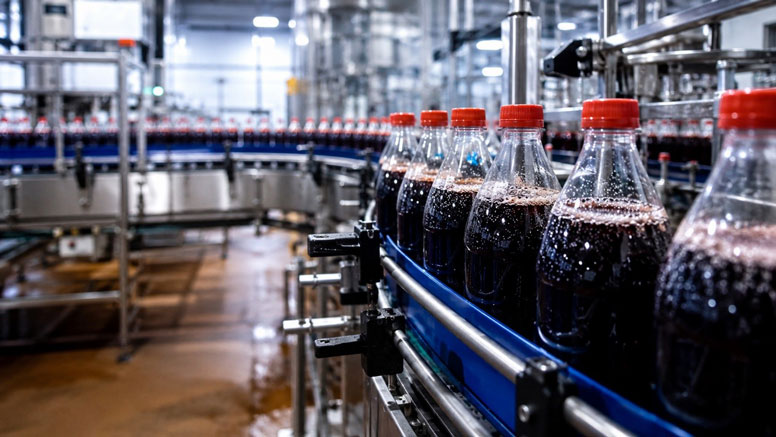
Over the past few decades, PET bottles have become one of the most important forms of packaging in the beverage industry. Their low weight, excellent transparency, and adequate mechanical strength have enabled them to replace many traditional packaging materials. PET bottles are also cost-effective to produce. However, unlike glass and metal, PET does not provide a complete barrier against gas transmission.
As a result, oxygen from the surrounding environment gradually permeates into the package, while carbon dioxide escapes from the bottle. This process leads to deterioration in the sensory quality of beverages, loss of carbonation, and an increased likelihood of changes in flavor and aroma during storage. In products such as carbonated soft drinks, malt beverages, fruit juices, and other oxygen-sensitive beverages, this issue becomes particularly critical.
Strategies for Reducing Gas Permeability in Bottles
To overcome the inherent limitations of PET, several technologies have been developed. Multilayer structures, barrier additives, oxygen scavengers, and surface coatings are among the most important approaches.
Multilayer structures reduce gas permeability by incorporating a barrier layer between polymer layers. However, the complexity of manufacturing is a significant drawback. Recycling such bottles is also challenging. Additives dispersed within the polymer matrix can improve bottle performance, but their use is often limited by increased costs. These additives also present difficulties in achieving very high barrier performance.
Oxygen scavengers can remove permeating oxygen or residual oxygen present in the bottle headspace. Nevertheless, concerns such as discoloration, limited absorption capacity, and the complexity of process control have restricted their application to specific uses. In this context, surface coatings have emerged as one of the most attractive solutions, as they provide enhanced performance without significantly altering the bottle structure.
Plasma Coatings and Their Operating Principles
In plasma coating technology, only the inner surface of the bottle is modified. Unlike many alternative approaches that alter the entire bottle structure, this method significantly reduces permeability by depositing an ultrathin layer with nanometer-scale thickness.
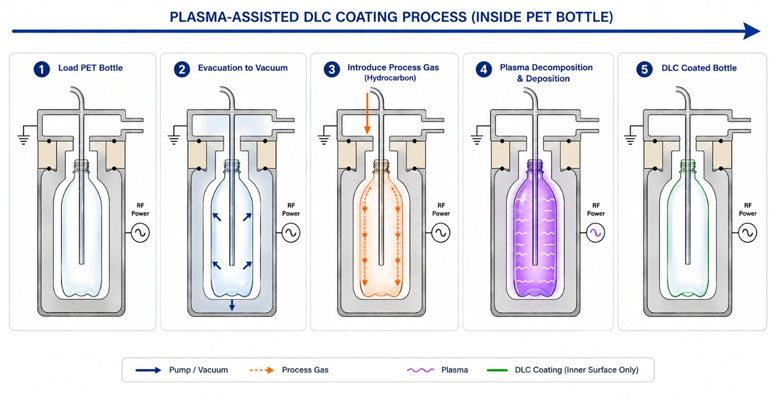
The process begins by placing the bottle in a vacuum chamber, where the air inside is evacuated. A precursor gas is then introduced into the bottle and excited into a plasma state under the influence of an electromagnetic field. The reactive species generated within the plasma deposit onto the inner surface of the bottle, forming a dense and uniform coating.
An ideal coating should simultaneously exhibit several characteristics, including extremely low thickness, high transparency, sufficient flexibility to withstand bottle deformation, chemical stability in contact with the packaged contents, and compatibility with high-speed industrial production.
These coatings are typically only a few tens of nanometers thick—thousands of times thinner than the diameter of a human hair—yet they can substantially improve the gas-barrier performance of bottles.
Carbon-Based and Silica-Based Coatings: Two Major Industrial Approaches
Carbon-based coatings are among the most widely used commercial technologies. These coatings possess a dense structure and provide not only an effective barrier against gases but also excellent chemical resistance.
The second major category consists of silica-based coatings, which exhibit a completely transparent, glass-like appearance. This characteristic has made them particularly attractive for applications in which product appearance is of great importance.
Carbon coatings generally offer superior stability, whereas silica-based coatings provide aesthetic advantages through their exceptional transparency. The selection between these two technologies depends on the product type, storage conditions, visual requirements, and economic considerations.
Commercialization of Plasma Coating Technology
Plasma coating technology has long progressed beyond the laboratory stage and entered industrial production. Today, major manufacturers of packaging machinery have developed high-capacity coating systems capable of processing thousands of bottles per hour.
Optimization of processing conditions, reduction of coating times, and improvements in coating uniformity have played crucial roles in the successful commercialization of this technology. These advances have transformed plasma coatings into a practical solution for the beverage industry.
Benefits Beyond Shelf-Life Extension
Plasma coatings can substantially reduce oxygen ingress into bottles and carbon dioxide loss from them. This contributes to preserving the sensory quality of beverages and extending their shelf life.
Improved gas barrier performance also enables the use of lighter-weight bottles in certain applications without compromising product protection. Consequently, manufacturers can reduce their consumption of raw materials.
Because plasma coatings add only a negligible amount of mass, they have minimal impact on recycling streams and demonstrate better compatibility with circular economy objectives than some alternative technologies.
Reduced material consumption, extended product shelf life, and lower losses associated with quality deterioration can collectively provide significant economic benefits for producers.
Challenges and Limitations
The implementation of plasma coating systems requires specialized equipment and relatively high initial investment, which may present barriers for some manufacturers.
Achieving uniform coatings in bottles with complex geometries demands precise control of process parameters. Even minor defects within the coating structure can adversely affect the barrier performance of the bottle.
The long-term stability of these coatings when exposed to different food and beverage products remains an important consideration in the development of next-generation plasma coating technologies.
The Future of Thin-Film Technologies in Packaging
Growing economic and environmental pressures are driving the packaging industry toward the adoption of lighter bottles. Under these circumstances, thin-film technologies can play a vital role in maintaining packaging performance.
Although these technologies have primarily focused on PET bottles, extensive research is underway to apply plasma coatings to other packaging polymers as well.
Surface engineering is gradually becoming a key tool in the design of advanced packaging systems—an approach that enhances performance through intelligent nanoscale modifications rather than by increasing material thickness and consumption.
Conclusion
Plasma coatings have demonstrated that solving complex challenges in the packaging industry does not always require extensive modifications to material structures. Sometimes, an invisible nanometer-thick layer that modifies only the inner surface of a bottle can help preserve product quality, reduce raw material consumption, improve economic efficiency, and support the transition toward more sustainable packaging solutions. These advantages have positioned plasma coating technology as one of the most promising pathways for the next generation of beverage packaging.
FAQ
1. Why is gas permeability in PET bottles considered a problem?
PET plastic does not provide a complete barrier against gas transmission; therefore, oxygen can enter the bottle and carbon dioxide (beverage carbonation) can escape. This leads to a decline in quality, flavor alteration, and reduced shelf life of the beverages.
2. How does plasma coating technology work in bottles?
In this method, the air inside the bottle is evacuated in a vacuum chamber, and a precursor gas is converted into plasma under the influence of an electromagnetic field. Then, a very thin layer (at the nanometer scale) is deposited on the inner surface of the bottle, acting as a resistant barrier against gas transmission.
3. What are the main types of plasma coatings in the industry?
The two main approaches include “carbon coatings” (with high chemical resistance and durability) and “silicate or silicon oxide coatings” (with a completely transparent, glass-like appearance).
4. Do plasma coatings hinder the recycling of plastic bottles?
No. Since the mass and thickness of this nanometric layer are highly negligible, it has a limited impact on the recycling process and is fully compatible with circular economy and environmental goals.
5. What are the most important challenges of using plasma technology in the packaging industry?
The need for a high initial investment for specialized equipment, the difficulty in achieving a uniform coating for bottles with complex geometries, and the necessity of layer stability during long-term contact with various beverages are among the most important challenges of this technology.
