
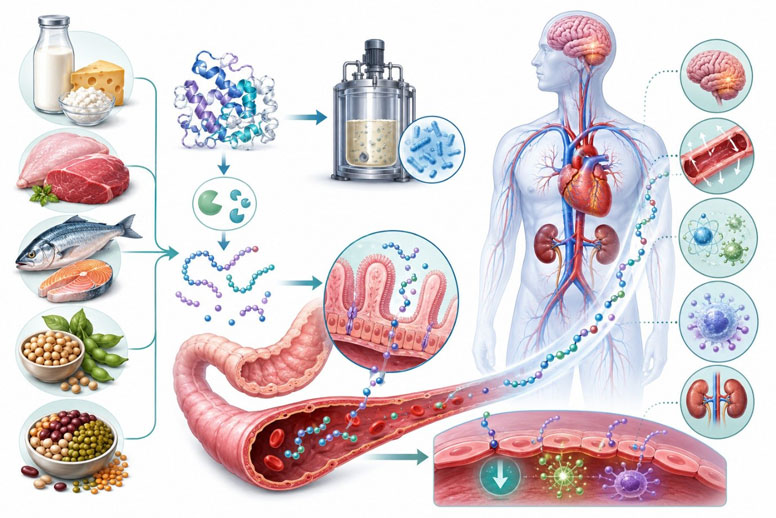
Bioactive peptides are short amino acid chains derived from the enzymatic hydrolysis of natural proteins found in sources such as milk, meat, cereals and plants. Despite their small size, these compounds play significant roles in critical biological processes, including molecular recognition, signal transduction, development, growth and cellular regulation. The biological properties of these peptides are highly dependent on the type and composition of the amino acids, their sequence, polarity, hydrophobicity/hydrophilicity and their acidic or basic spatial structure. The presence of specific amino acids influences the stability, reactivity and biological function of the peptide.
Due to their low molecular weight, high bioavailability, nutritional value and lack of adverse effects, bioactive peptides have broad potential for use in functional foods, pharmaceutical products formulations, making them recognized as safe and efficient compounds in the food and health industries.
Generation of Bioactive Peptides
The generation of bioactive peptides in food products is achieved through enzymatic processes using proteases from various sources. Among these methods, commercial enzymatic hydrolysis is the most widely used in the food and functional food industries due to its high degree of control, feasibility under mild conditions, reduction of by-product formation, environmental compatibility and the ability to produce bioavailable peptides. In this process, the use of proteases breaks peptide bonds within the protein structure, releasing shorter fragments. Selecting the appropriate enzyme is crucial, as the type of enzyme, cleavage pattern, reaction conditions, raw material characteristics and degree of hydrolysis determine the final peptide composition and the level of bioactivity. Smaller peptides typically exhibit greater stability under digestive conditions and have a higher probability of crossing the intestinal barrier into the bloodstream, making them more valuable for health-oriented products.
To increase production efficiency, strategies such as combining multiple enzymes, using immobilized enzymes, membrane reactors and novel technologies can be employed. These approaches enhance process yield, improve product uniformity, reduce enzyme consumption and lower production costs. Additionally, software tools based on biological models—used for simulating hydrolysis, predicting bioactivity, assessing toxicity and evaluating allergenicity, play an effective role in selecting protein sources and appropriate process conditions, although their results must be verified through experimental testing.
Technological advancements in extraction have enabled food resources and even industrial by-products—such as food processing residues—to become valuable sources for producing bioactive peptides. Initially, the raw material is prepared using an appropriate method to release the protein. Subsequently, the hydrolysis process generates a pool of peptides, followed by extraction and separation once the desired concentration and characteristics are achieved.
Technologies such as ultrasound, microwave, high hydrostatic pressure, pulsed electric fields, subcritical water and supercritical fluids can be used as pre-treatment or enhancer methods. These technologies improve extraction yield and the quality of the produced peptides by altering protein structure, increasing tissue or membrane permeability, exposing cleavage-sensitive regions, facilitating protein release, reducing solvent consumption and reduction of processing time.
In enzymatic hydrolysis, controlling factors such as temperature, time, pH, substrate concentration and enzyme activity level is essential. Enzymes such as Alcalase and Flavourzyme are widely used in the production of bioactive peptides due to their high efficiency. Conversely, improper conditions can lead to enzyme denaturation, reduced yield and the production of unwanted compounds.
Furthermore, to evaluate peptide stability during digestion, simulated gastrointestinal digestion using gastric and intestinal enzymes is utilized. Overall, the integration of targeted hydrolysis, green technologies, predictive tools and experimental testing facilitates the production of high-quality peptides for use in food, pharmaceutical and functional industries.
Purification
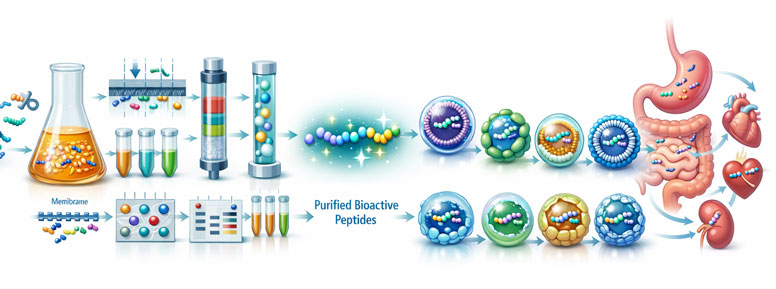
Purification is a critical step in identifying and evaluating peptide performance. Methods such as ultrafiltration, various forms of chromatography, electrophoresis and high-performance liquid chromatography (HPLC) are used to separate peptides based on molecular weight, electrical charge, or structural features. Ultrafiltration is widely employed due to its ability to separate peptides small molecular weight, its speed, cost-effectiveness and the capability to perform concentration, desalting and fractionation. Since lower-molecular-weight peptides often exhibit greater bioactivity, ultrafiltration is an efficient stage for enriching the bioactive fraction of a sample.
Porous adsorption resins are used to remove polysaccharides and salts, although the need for frequent washing and regeneration can be challenging. Despite longer processing times and limited injection capacity, chromatographic methods provide high precision in separating complex components. Combining several methods usually yields the best results for producing pure peptides at both research and industrial scales.
Identification of Bioactive Peptides
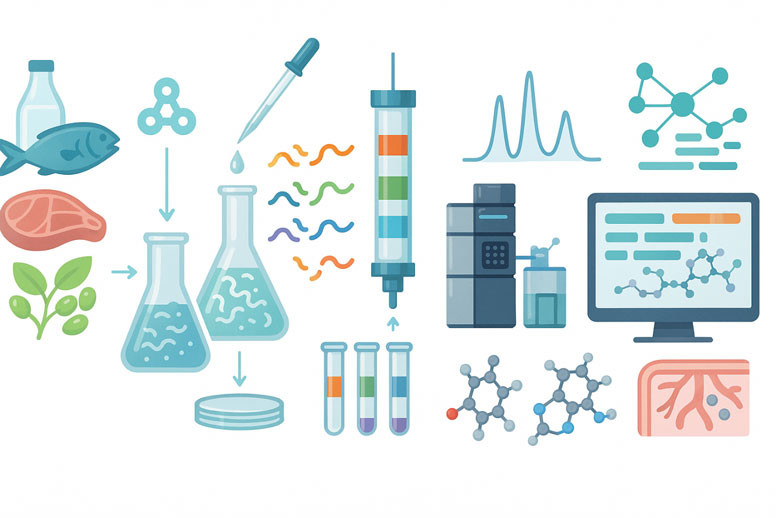
Determining the structure and sequence of bioactive peptides is essential for understanding their biological function and identifying effective peptides. Mass spectrometry coupled with liquid chromatography is one of the most precise tools for peptide analysis.
Nevertheless, some limitations, such as the difficulty in identifying peptides with identical molecular weights or incomplete species, remains. Alongside these instruments, scientific databases containing diverse peptide data, play a crucial role in storing and analyzing information related to antioxidant, anti-inflammatory, antimicrobial, anti-cancer and blood pressure-regulating peptides. These databases enable researchers to compare new peptides with known samples and predict their functional characteristics.
Functionality of Bioactive Peptides
Due to their diverse functions, high safety profile and natural origin, bioactive peptides are among the most valuable compounds in the development of functional and health-oriented foods. These peptides can be effective in regulating metabolism, cell signaling, immune system enhancement, inflammation reduction and maintaining biological homeostasis. One of their most significant functions is antioxidant activity. By scavenging free radicals, preventing lipid oxidation, increasing reducing power and stimulating cellular defense enzymes, these peptides protect the body against oxidative damage. Anti-inflammatory peptides, by inhibiting inflammatory signaling pathways, play a role in reducing chronic inflammation and metabolic, cardiovascular and neurological diseases. Immunomodulatory peptides also enhance immune system performance by stimulating immune cells and increasing the body’s defense capacity.
In terms of food safety, antimicrobial peptides play a significant role in controlling contamination, extending shelf life and designing active packaging by disrupting the membranes of microorganisms. Furthermore, peptides capable of inhibiting the angiotensin-converting enzyme (ACE) are a natural option for blood pressure control and promoting heart health. Some peptides also enhance the absorption of minerals by chelating them, thereby influencing energy metabolism, protein synthesis and lipid reduction. Overall, these features demonstrate that bioactive peptides are among the most important focal points for developing next-generation nutritional products.
Sensory Properties
The sensory properties of bioactive peptides, particularly taste, play a significant role in consumer acceptance. The taste of these peptides is a result of their amino acid composition and chain length, manifesting as sweet, bitter, sour, salty, or umami. Some peptides act as precursors in the Maillard reaction, contributing to the improvement of aroma and flavor in food products. Bitterness is the most common sensory issue with peptides and is often associated with hydrophobic and aromatic amino acids.
Sourness is linked to the release of hydrogen ions, while saltiness is related to the presence of cations and ionic groups. Salty peptides are used in the production of low-sodium foods, particularly for individuals with hypertension. The sweetness of some peptides can be utilized to reduce bitterness or substitute a portion of sugar. Umami taste, is a desirable option for producing innovative seasonings. Understanding the structure-taste relationship plays a key role in formulating functional products and enhancing the consumer sensory experience.
Conclusion
Food-derived bioactive peptides are valuable and safe compounds obtained from various sources such as milk, meat, cereals, plants and other edible protein sources. Due to their appropriate absorption and the dependence of their function on amino acid sequence, they can possess important properties such as antioxidant, anti-inflammatory, antimicrobial, blood pressure-regulating and immune-boosting activities. Their production and identification are carried out using precise methods, including enzymatic hydrolysis, microbial fermentation, ultrafiltration, chromatography and mass spectrometry. Furthermore, their sensory attributes are important in food design and they can play a significant role in the development of next-generation health-oriented and functional foods.
In recent decades, various studies have focused on designing precise engineered processes for generating peptides or their precursors within food products, or developing delivery systems to transport these compounds to the intestine.
FAQ
What is a bioactive peptide?
A bioactive peptide is a short chain of amino acids released from food proteins that can exert beneficial effects on human health.
How are bioactive peptides produced?
These peptides are primarily produced through the enzymatic hydrolysis of food proteins such as milk, meat, cereals and plants.
What are the most important properties of bioactive peptides?
Their most important properties include antioxidant, anti-inflammatory, antimicrobial, blood pressure-regulating and immune-boosting activities.
Why are bioactive peptides important in functional foods?
Because they have a natural origin, good bioavailability and health-promoting properties and they can enhance the nutritional value of food products.
How do the sensory properties of bioactive peptides affect food products?
Properties such as bitterness, saltiness, sweetness and umami directly influence the taste of the product and its level of consumer acceptance.
