
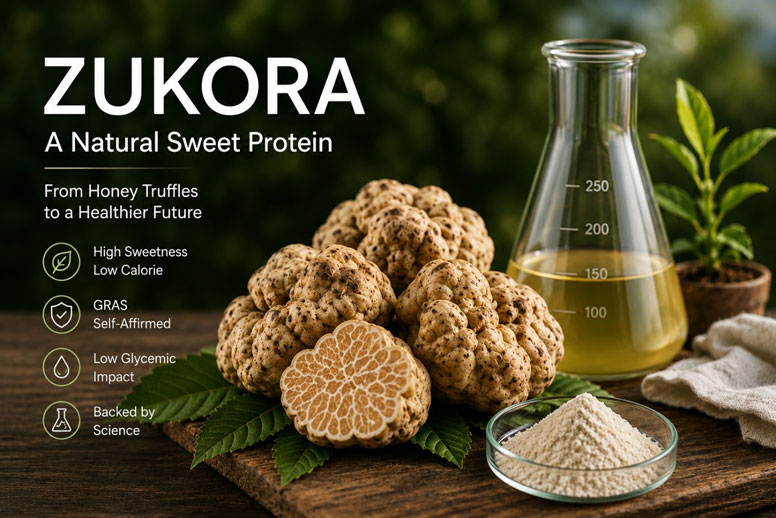
The increasing prevalence of diseases such as obesity, diabetes, and metabolic disorders has significantly driven up the demand for sugar alternatives, as consumers strive to reduce their sugar intake while preserving the desirable taste characteristics of food. Consequently, alternative sweeteners have garnered widespread attention.
Alternative sweeteners encompass artificial sweeteners, sugar alcohols, and natural sweeteners. Artificial sweeteners, such as aspartame and sucralose, are synthetically produced and can provide intense sweetness without contributing energy (calories). In contrast, sugar alcohols like xylitol and sorbitol, which have natural origins, offer a pleasant sweetness along with fewer calories. Moreover, natural sweeteners such as stevia and honey have gained increasing popularity due to their natural origins and potential health benefits.
The evolution of the sweetener industry reflects a broader societal lifestyle shift towards healthier nutrition and the incorporation of functional ingredients tailored to consumer preferences.
Safety and Health Concerns Regarding Sweeteners
Although sugar alternatives are often promoted as healthier options, their safety and long-term effects on human health remain a subject of ongoing scientific debate. Current concerns regarding artificial sweeteners primarily revolve around their potential association with metabolic syndrome and other health disorders, underscoring the necessity for more rigorous scientific studies.
Furthermore, the approaches to health assessment and the regulatory frameworks governing alternative sweeteners vary significantly across different countries—a factor that can profoundly influence consumer trust and acceptance. Therefore, as the demand for these compounds continues to grow, a comprehensive evaluation of their impacts on human health, safety, and the environment is imperative for consumers, manufacturers, and regulatory authorities alike.
Introduction to the Honey Truffle: Origin and History
The honey truffle, renowned for its uniquely sweet flavor, has a documented history dating back to 1588. This fungus is native to Europe and Asia and thrives predominantly in sandy soils with a slightly alkaline pH, particularly along the Danube River, where it grows in association with the roots of the black locust tree (Robinia pseudoacacia). Over time, the honey truffle has gradually made its way into food markets beyond Hungary, although its primary cultivation remains concentrated in this region.

A symbiotic relationship exists between the root system of the Robinia pseudoacacia tree and the Mattirolomyces terfezioides fungus. In this mutualistic association, the tree’s roots provide a stable and nutrient-rich environment essential for the truffle’s growth; in return, the truffle enhances the tree’s capacity to absorb minerals. This mutually beneficial interaction has been the focal point of numerous ecological studies, highlighting the critical importance of biodiversity along the banks of the Danube River and its surrounding ecosystems.
Interest in honey truffles has also grown due to their potential health benefits. These benefits are primarily attributed to the nutritional composition of these fungi, which includes trace amounts of vitamins C, A, and K, as well as valuable minerals such as phosphorus, copper, zinc, and manganese. The natural sweetness of the honey truffle is mainly derived from a specific protein called Myd, which has been extensively studied for its ability to modulate the sensation of sweetness, thereby further elevating the scientific and practical significance of the honey truffle.
Research on the Stability and Function of the Myd Protein
Researchers are currently investigating how the Myd protein interacts with human taste receptors, as well as evaluating its stability under various processing conditions. Studies have demonstrated that Myd can be utilized in dairy products, baked goods, and a variety of beverages without losing its sweetening properties; remarkably, it maintains its functionality even after pasteurization.
This characteristic makes the Myd protein an attractive option for food industry manufacturers, aligning with the increasing consumer demand for natural, low-calorie sweeteners. Furthermore, the amino acid composition of this protein can significantly contribute to its functional properties and stability, enhancing its applicability in food product formulations.
However, although initial results present Myd as a promising natural sweetener, further studies are essential to fully elucidate its metabolic effects, nutritional value, and overall health benefits.
Applications of the Myd Protein
Purified Myd protein serves as a key ingredient in formulations designed to enhance sweetness intensity across a wide range of food products. Specifically, formulations containing this protein can be engineered to exhibit greater stability against degradation caused by temperature, osmotic pressure, and pH variations—characteristics that are crucial for preserving the protein’s functionality during manufacturing and storage processes.
Mechanism of Action: Interaction with Taste Receptors
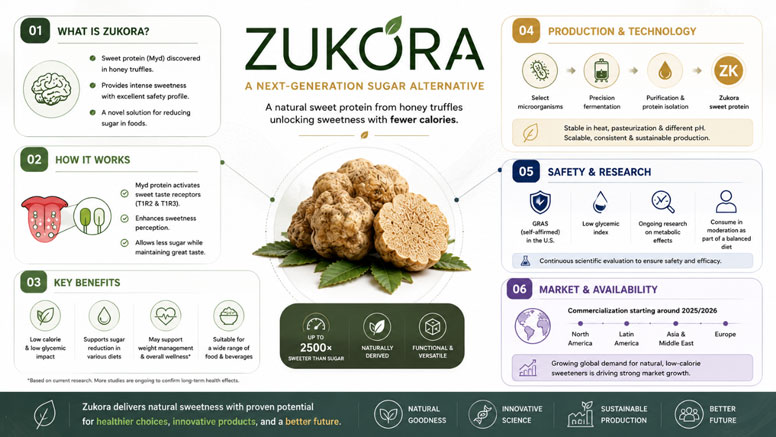
The mechanism of action of the Myd protein, extracted from the Hungarian honey truffle, is based on its specific interaction with the receptors responsible for sweet taste perception. This protein acts as an agonist for the T1R2 and T1R3 receptors, which are the two primary components of the sweet taste receptor in humans. The binding of the Myd protein to these receptors modulates the activity of the sweet taste perception system, thereby intensifying the sweetness of the products.
Generally, the modulation of sweetness perception is categorized into two main types: activating and inhibitory. The Myd protein falls into the category of activating polypeptides. By facilitating the transmission of taste signals, it enhances the perception of sweetness without the need to add large quantities of sugar.
Zukora: Production and Technology
Zukora is a novel sweetening protein derived from the Hungarian honey truffle and produced using the advanced technology of Precision Fermentation. In this technology, engineered microorganisms are utilized to produce high quantities of the sweetening protein.
Depending on the application, Zukora’s sweetening power can be up to 2,500 times that of sucrose. Its extremely high sweetness intensity means that a very small amount is sufficient to achieve the desired sweetness. Therefore, this protein can maintain the desirable taste of food products without adding calories, making it a suitable replacement for conventional sweeteners.
Although Zukora’s nutritional composition may vary, the protein is typically produced to have negligible calories. This characteristic aligns with the demand for low-calorie sweeteners. The primary goal behind Zukora’s development is to offer a versatile sweetener that supports a healthy lifestyle while preserving the sensory quality of products.
Production Process in Bioreactors and Its Advantages
Zukora is produced in specialized bioreactors. In this process, microorganisms such as yeasts or fungi are genetically engineered to synthesize the sweetening protein with high efficiency and uniform quality. This technology overcomes the limitations of traditional sugar production, such as dependency on climatic conditions, and enables sustainable and scalable industrial production.
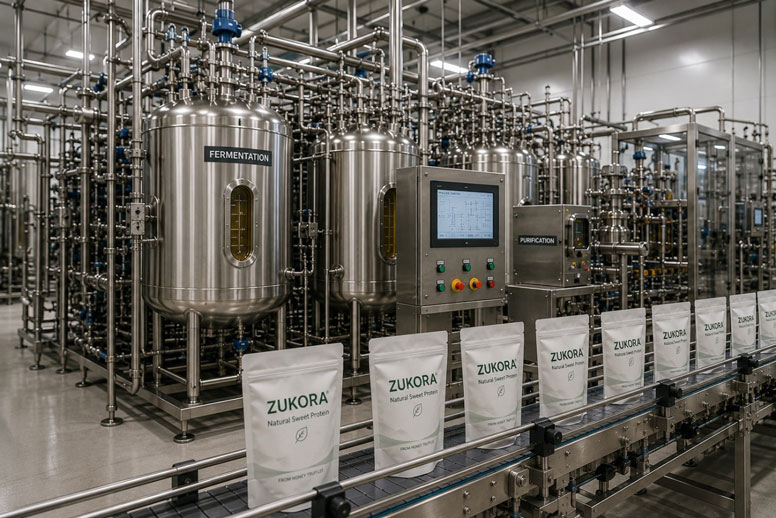
After the fermentation process is complete, the produced protein is extracted through various purification and separation steps. MycoTechnology has successfully scaled up Zukora production from a laboratory scale to commercial production at its 86,000-square-foot facility in Aurora, Colorado, USA.
Low Glycemic Index and Role in Weight Management
As a suitable alternative to common sugars, Zukora has a low glycemic index, and its consumption does not cause a significant increase in blood glucose concentration. This feature makes Zukora a suitable option for individuals with diabetes. Additionally, studies indicate that low-calorie sweeteners like Zukora can play an effective role in weight management and obesity prevention.
Safety Status (GRAS) and Acceptable Daily Intake (ADI)
Zukora has achieved “Generally Recognized as Safe” (GRAS) status in the United States. This status signifies that a panel of independent experts has confirmed the compound’s safety for use in food. For such substances, an Acceptable Daily Intake (ADI) is typically determined based on animal studies, applying a safety factor of 100. Although a specific ADI has not been established for Zukora, its GRAS status indicates that it has passed rigorous safety evaluations.
Nonetheless, consumer awareness of the properties of new food ingredients is important. Current studies are still investigating the potential side effects of sweeteners, including digestive disturbances and metabolic effects. Regulatory agencies like the FDA continuously review new scientific evidence and update the safety assessments of these compounds as needed.
Conclusion: Potential Benefits Alongside the Need for Moderation
In summary, Zukora can offer potential health benefits, but like any other food ingredient, it should be consumed in moderation. Although some studies have suggested a possible link between long-term consumption of certain sweeteners and an increased body mass index, systematic reviews show that the proper use of low-calorie sweeteners can help reduce daily energy intake.
Therefore, practicing moderation and adhering to a healthy dietary pattern is the best approach to benefit from Zukora as a sugar substitute.
Market and Availability
The market for sweeteners derived from honey truffles has significant growth potential, given the increasing consumer demand for healthier sugar alternatives. MycoTechnology has projected that the commercial launch of Zukora will begin in North America from 2025 to 2026, followed by expansion into markets in Latin America, Asia, the Middle East, and Europe.
This market development strategy aligns with the growing global trend of using natural sweeteners. Increased public health awareness, coupled with the rising prevalence of obesity and diabetes, has led to a continuous increase in demand for low-calorie, healthy sweeteners. In this context, Zukora is well-positioned to capture a significant share of the global sweetener market.
Frequently Asked Questions
What is Zukora?
Zukora is a natural sweetening protein derived from the honey truffle, developed to provide high sweetness with very low calories.
How is Zukora produced?
Zukora is produced using precision fermentation technology. In this process, engineered microorganisms produce the sweetening protein under controlled conditions.
How sweet is Zukora compared to sugar?
Zukora’s sweetening power is several times greater than that of regular sugar; therefore, only a small amount is needed to achieve the desired sweetness.
Can Zukora be used in food and beverages?
Yes. Zukora can be used in a wide range of food products, including beverages, desserts, dairy products, baked goods, and other processed foods.
Is Zukora an environmentally sustainable option?
Yes. The production of Zukora through precision fermentation requires fewer natural resources compared to traditional sugar production methods and is considered a more sustainable and environmentally friendly approach in terms of land use, water consumption, and environmental impact.
