
Table of Contents
- What is Smart Agriculture?
- What is the Difference Between Traditional and Smart Agriculture?
- Why Is Smart Agriculture Important?
- Technology in Agriculture and Its Role in Industry Transformation
- The Internet of Things in Agriculture: The Heart of Digital Farming
- Precision Agriculture: A Step Toward Sustainable Productivity
- The Role of Artificial Intelligence in Smart Agriculture
- Smart Irrigation Systems and Water Resource Management
- The Use of Drones in Smart Agriculture
- Smart Agriculture Tools and Practical Applications
- Benefits of Smart Agriculture for Farmers and Society
- Cost Reduction Through Smart Agriculture
- Smart Agriculture and Productivity on a National Scale
- The Future of Smart Agriculture in Iran
- Challenges and Barriers to Digital Agriculture Development
- The Role of Innovation Centers Such as Grownida
- Sustainable Agriculture: The Link Between Technology and the Environment
- Conclusion
- Frequently Asked Questions (FAQ)
1. What Is Smart Agriculture?
Smart agriculture is a modern approach that integrates advanced technologies such as IoT, sensors, AI, and big data to optimize agricultural production. This method not only focuses on increasing productivity but also emphasizes environmental sustainability and reducing resource consumption.
2. What Is the Difference Between Traditional and Smart Agriculture?
In traditional farming, decisions are largely based on experience and trial-and-error. In contrast, smart agriculture uses precise data from soil, climate, and crops to provide scientific, data-driven decisions. This reduces errors and increases efficiency.

3. Why Is Smart Agriculture Important?
- Meeting the food needs of a growing population
- Reducing pressure on natural resources
- Increasing food security
- Moving toward sustainable, climate-adaptive farming
4. Technology in Agriculture and Its Role in Industry Transformation
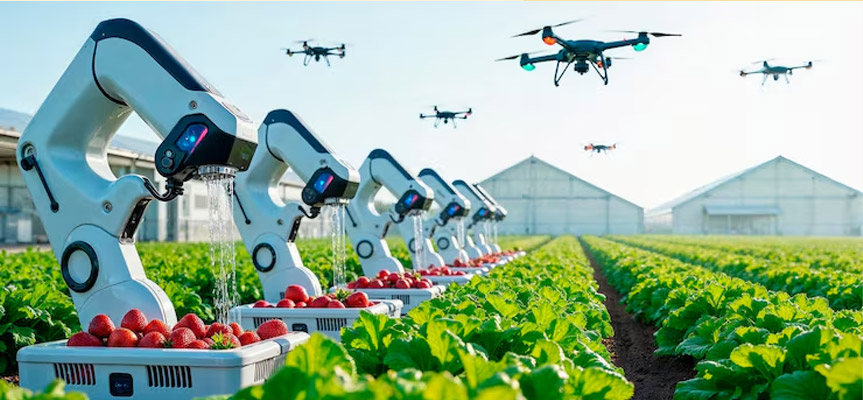
Agricultural technology includes drones, sensors, smart irrigation systems, farm management software, and harvesting robots. These tools enable farmers to make better decisions and achieve higher yields.
5. The Internet of Things in Agriculture: The Heart of Digital Farming
IoT is a key element in digital farming. Sensors collect data on soil moisture, temperature, and plant conditions, transmitting them to central management systems. These data are then used for precise irrigation, fertilization, and pest control.
6. Precision Agriculture: A Step Toward Sustainable Productivity
Precision farming is based on real-time and accurate data. Its goal is to reduce waste, optimize resource usage, and increase yield per unit of land. For example, aerial mapping with drones helps farmers identify weak spots in their fields.
7. The Role of Artificial Intelligence in Smart Agriculture
AI can analyze big data to predict the best harvesting time, water requirements, and the likelihood of plant diseases. These capabilities not only increase productivity but also reduce farmers’ financial risks.
8. Smart Irrigation Systems and Water Resource Management
Water scarcity has become a serious challenge in many countries. Smart irrigation systems use sensors to measure soil moisture and irrigate only when needed, significantly reducing water consumption.

9. The Use of Drones in Smart Agriculture
Drones are effective tools for monitoring fields. They can capture detailed images of plant conditions, growth, and even pest presence. Their use increases the speed and accuracy of farmers’ decision-making.
10. Smart Agriculture Tools and Practical Applications
Tools such as soil sensors, harvesting robots, weather forecasting systems, and analytical software make production more automated and precise.
11. Benefits of Smart Agriculture for Farmers and Society
- Increased crop productivity
- Reduced water and energy consumption
- Lower production costs
- Improved quality and quantity of products
- Environmental protection
12. Cost Reduction Through Smart Agriculture
One of the main reasons for adopting digital agriculture is the reduction of operational costs. With technology, farmers can optimize resource use, leading to lower expenses.
13. Smart Agriculture and Productivity on a National Scale
At the national level, smart agriculture can enhance food security and improve the agricultural economy. Increased productivity means greater exports and reduced imports of agricultural products.
14. The Future of Smart Agriculture in Iran
Iran faces challenges such as water scarcity and climate change. Smart agriculture can be a solution to these problems. Government support, investment in startups, and innovation centers are key success factors in this path.

15. Challenges and Barriers to Digital Agriculture Development
- High equipment costs
- Lack of education and necessary skills
- Resistance to change among traditional farmers
- Insufficient internet infrastructure in rural areas
16. The Role of Innovation Centers Such as Grownida
Innovation centers like Grownida Innovation Center can play a crucial role in expanding smart agriculture by providing platforms for research, development, and commercialization of new technologies. Grownida supports startups and offers technological solutions, creating a bridge between universities, industry, and farmers.
17. Sustainable Agriculture: The Link Between Technology and the Environment
The ultimate goal of smart agriculture is not only higher yields but also sustainable development. Reduced resource consumption, pollution control, and biodiversity preservation are direct outcomes of technology in farming.
18. Conclusion
Smart agriculture is no longer a luxury but an inevitable necessity for the future of the food industry. Through IoT, AI, precision farming, and modern tools, productivity can be increased while conserving limited resources. For Iran to achieve sustainable food security, support for innovation, infrastructure investment, and farmer training are essential.
19. Frequently Asked Questions (FAQ)
1. What is smart agriculture?
Smart agriculture is the use of modern technologies such as IoT and AI to improve the agricultural production process.
2. What are the applications of smart agriculture?
From optimizing irrigation to managing plant diseases, smart agriculture has widespread applications in boosting productivity.
3. Why is smart agriculture important?
Because it helps ensure food security, reduces costs, and protects the environment.
4. How does smart agriculture increase productivity?
By analyzing data and enabling precise decision-making, it reduces resource use and improves final yield.
5. What is the difference between traditional and smart agriculture?
Traditional farming relies on experience, while smart agriculture is based on data and technology.
