
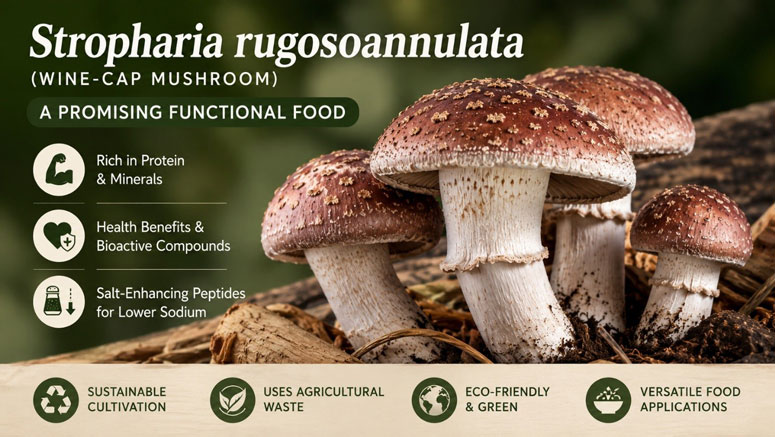
Stropharia rugosoannulata, also known as the wine-cap mushroom, is highly valued for its nutritional value, medicinal properties, and ecological benefits. The Food and Agriculture Organization (FAO) recommends its cultivation in developing countries, and it has become one of the leading cultivated mushrooms worldwide. China is the world’s largest producer, owing to the mushroom’s ability to grow on agricultural waste and the country’s support through poverty alleviation programs. Its firm texture and high contents of protein, essential amino acids, and minerals, particularly potassium, have contributed to its growing popularity. Cultivation of this mushroom improves soil quality and reduces environmental pollution by utilizing agricultural and forestry residues as substrates.
Recent studies have demonstrated that its taste-enhancing peptides can reduce sodium intake by enhancing salt perception, making this mushroom valuable for both the food and health industries. With the rapid modernization of China’s mushroom industry, Stropharia rugosoannulata has become an important component of the mushroom value chain.
Overview of Stropharia rugosoannulata
Stropharia rugosoannulata, commonly known as the wine-cap mushroom or giant Stropharia, is a large edible fungus recognized for its nutritional, medicinal, and ecological significance. The Food and Agriculture Organization (FAO) recommends its cultivation in developing countries, and it ranks among the top ten edible mushrooms in international trade.
Morphological Characteristics
S. rugosoannulata is distinguished by its large size and robust morphology.
Cap: When young, the cap is white and gradually changes to a wine-red or reddish-brown color as it matures. Initially hemispherical, it expands to become convex or nearly flat, reaching up to 25 cm in diameter. The cap surface is typically covered with characteristic fibrous white scales.
Flesh and Gills: The flesh is thick, firm, and white. The gills are initially white and gradually become purplish-gray as the spores mature.
Stipe (Stem): The white stipe can reach up to 15 cm in length and 4 cm in diameter, often with a swollen base. One of its most distinctive identifying characteristics is the large, wrinkled annulus located near the upper part of the stipe, which is easily detachable.
Spores and Mycelium: The mycelium is white, and the mushroom produces a dark purplish-brown spore print.
Distribution and Habitat
Wild populations of Stropharia rugosoannulata are naturally distributed throughout temperate regions of Europe, North America, and Asia. In China, it has been reported in several provinces, including Tibet, Yunnan, Jilin, Sichuan, and Gansu. This species plays an important ecological role by degrading agricultural and forestry residues rich in cellulose and lignin. Under natural conditions, fruiting bodies typically appear during spring and autumn, either singly or in clusters.
Its preferred habitats include:
- Grassy areas and forest edges
- Woodchip piles
- Compost heaps containing horse or cattle manure
Nutritional and Bioactive Composition
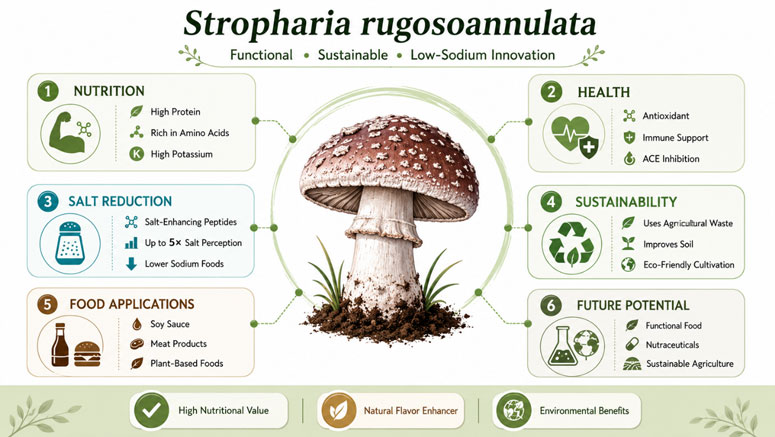
Stropharia rugosoannulata is highly valued for its rich nutritional profile and diverse bioactive compounds, making it not only an excellent edible mushroom but also a promising source of natural therapeutic agents.
Proximate Composition
The mushroom is an excellent source of protein, carbohydrates (including dietary fiber), B-complex vitamins, and unsaturated fatty acids. It is characterized by a high protein content and low-fat content. The amino acid profile of S. rugosoannulata is well balanced and of high nutritional quality, with protein accounting for more than 30% of its dry weight.
Minerals
This mushroom contains higher concentrations of minerals than many commonly cultivated mushrooms, including shiitake, oyster, and button mushrooms. It possesses one of the highest potassium contents among edible mushrooms, reaching approximately 3.58 g·100 g-1 of dry weight.
Health Standards
This mushroom is considered safe for consumption because it does not produce hallucinogenic toxins, such as psilocybin. It is recognized for its crisp texture and rich flavor, which result from a complex mixture of compounds. The mushroom contains elevated levels of umami peptides, free amino acids, soluble sugars, organic acids, and taste-active nucleotides. Researchers have identified 47 distinct umami peptides, ranging from octapeptides to undecapeptides, that interact with human taste receptors T1R1 and T1R3.
Salty Peptides
Studies on the salt-enhancing properties of Stropharia rugosoannulata have demonstrated that specific peptides interact with human taste receptors to enhance salt perception. Although sodium chloride (NaCl) is the primary contributor to salty taste in foods, excessive sodium intake is strongly associated with an increased risk of hypertension and cardiovascular diseases.
Peptides derived from Stropharia rugosoannulata provide a unique combination of salty and umami flavors. At a concentration of 1 mg/mL, mushroom extracts exhibit a perceived saltiness approximately 1.4–2.5 times greater than that of an equivalent NaCl solution, with taste intensity increasing proportionally within specific concentration ranges.
The salt-enhancing activity of these peptides is attributed to their amino acid composition and sequence. Peptides containing acidic amino acid residues, particularly aspartic acid (D) and glutamic acid (E), including fragments such as DD, ED, and EE, play a dominant role in salt perception. Likewise, peptides containing arginine (R), including RP, VR, and RV, significantly enhance saltiness.
The major salt-enhancing peptides identified in S. rugosoannulata include:
- GQEDYDRLRPL, an 11-residue peptide
- RIEDNLVIIR, a 10-residue peptide
- KSWDDFFTR, a 9-residue peptide that exhibits exceptional receptor-binding affinity and considerable potential as a natural sodium substitute.
- ESPERPFL, an 8-residue peptide
At a concentration of 1 mg/mL, these peptides exhibit saltiness intensities ranging from 1.90 to 5.29 times greater than that of sodium chloride.
Proposed Mechanisms of Action
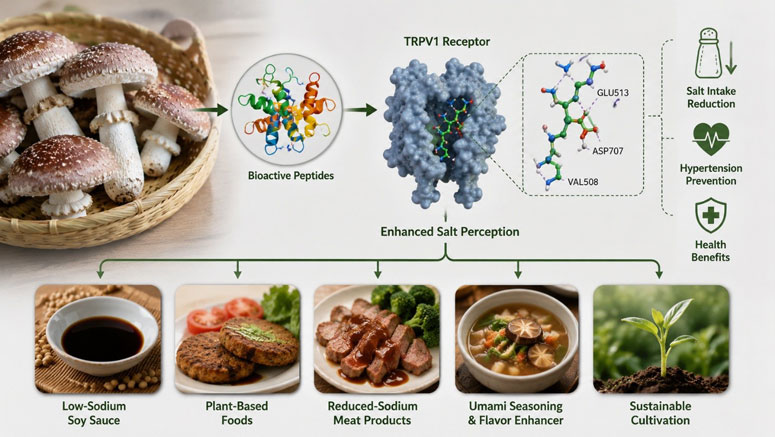
Recent advances in molecular docking and thermodynamic simulations have provided valuable insights into the mechanisms by which these peptides interact with human taste receptors. In Stropharia rugosoannulata, the salty peptides are primarily recognized by the TRPV1 receptor. The receptor interacts with several key amino acid residues, particularly GLU513, ASP707, and VAL508. On the peptide molecule, the N-terminal amino acid residue and aspartic acid (D) are the principal recognition sites involved in receptor binding. These molecular interactions are predominantly enthalpy-driven, as indicated by the negative values of enthalpy (ΔH) and entropy (ΔS) observed during peptide–receptor binding.
Beyond their taste-enhancing properties, certain peptides, particularly KSWDDFFTR, also exhibit antihypertensive activity through ACE inhibition. Consequently, these peptides have promising applications in both the food and pharmaceutical industries.
The use of Stropharia rugosoannulata as a natural sodium substitute supports the global demand for low-sodium diets aimed at reducing the incidence of hypertension and cardiovascular diseases. Peptide-rich extracts from this mushroom provide an effective strategy for reducing sodium content while maintaining the desired salty taste. Specifically, the peptides GQEDYDRLRPL, RIEDNLVIIR, KSWDDFFTR, and ESPERPFL exhibit saltiness intensities ranging from 1.90 to 5.29 times greater than equivalent concentrations of sodium chloride, making them promising partial replacements for NaCl in food formulations.
Advanced Processing
The production of nanoscale mushroom powder has been shown to enhance both the saltiness and aroma of Stropharia rugosoannulata, making it an effective ingredient for sodium-reduced food products. The mushroom is increasingly incorporated into processed meat products to enhance flavor while reducing added salt. For example, beef sauce containing diced wine-cap mushrooms utilizes the mushroom’s meaty texture and naturally occurring umami and salty peptides to maintain a rich, savory flavor profile. These peptides interact synergistically with meat proteins, enhancing flavor complexity while allowing sodium reduction without compromising sensory quality. Furthermore, Stropharia rugosoannulata is used in the production of umami-enhancing mushroom extracts and liquid seasonings through membrane separation and flavor-blending technologies.
Soy Sauce
Recent studies have led to the development of flavored soy sauce enriched with hot-water extracts of Stropharia rugosoannulata. These extracts naturally enhance the perceived saltiness and umami flavor of soy sauce while allowing for a reduction in sodium content.
Plant-based Foods
Cereal Integration: The mycelium of Stropharia rugosoannulata can be used to ferment cereal grains such as wheat, corn, and soybeans, resulting in mycelium-enriched cereal products designed for health-conscious consumers.
Texture and Flavor: The mushroom’s firm flesh and crisp texture make it well suited for plant-based foods and meat alternatives that require complex, natural seasoning with reduced sodium content.
Health-promoting Properties
The health-promoting effects of the wine-cap mushroom are attributed to its rich nutritional composition and diverse bioactive compounds.
Nutritional Richness: Stropharia rugosoannulata is a high-protein, low-fat food rich in essential amino acids and minerals, particularly potassium (approximately 3.58 g/100 g dry weight), making it beneficial for maintaining cardiovascular health.
Pharmacological Bioactives: The mushroom is a rich source of polysaccharides, polyphenols, sterols, and bioactive peptides. These compounds exhibit a wide range of biological activities, including antitumor, antioxidant, immunomodulatory, and hypoglycemic effects.
Peptides isolated from S. rugosoannulata have demonstrated antihypertensive activity through ACE inhibition, while its polysaccharides are being investigated for their potential to alleviate liver injury and combat obesity.
Waste Utilization: Stropharia rugosoannulata can be cultivated on a wide variety of agricultural biomass residues, including crop straw, tree litter, and livestock manure, thereby converting agricultural waste into valuable food products.
Ecological Conservation: In addition to efficiently utilizing agricultural wastes, the mycelium of S. rugosoannulata is capable of degrading organic pollutants, including wood preservatives and pharmaceutical contaminants found in wastewater. Furthermore, the spent mushroom substrate remaining after cultivation can be incorporated into agricultural soils to improve soil structure and fertility, thereby reducing dependence on chemical fertilizers.
Economic Accessibility: Cultivation of this mushroom requires relatively simple equipment and limited physical labor, making it an attractive option for rural communities and individuals with physical limitations in developing countries. Despite its considerable potential, deep-processed products currently account for less than 20% of the market, and high-purity bioactive extracts for pharmaceutical applications remain largely unavailable.
Global Expansion
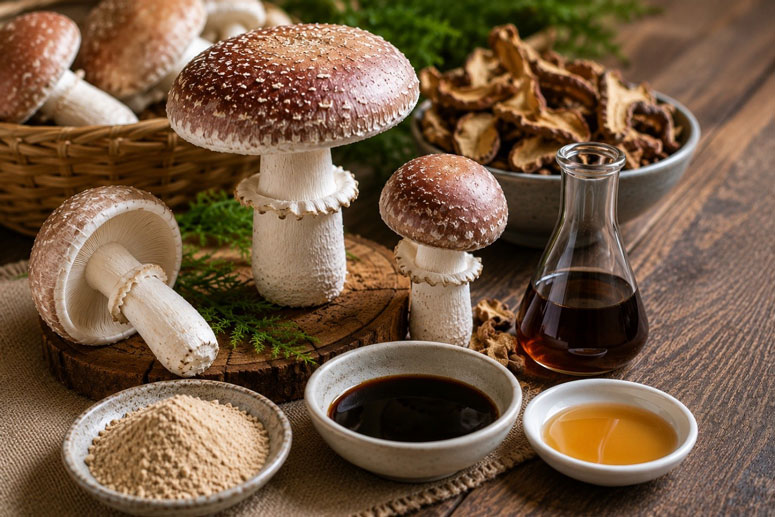
Owing to its adaptability to a wide range of climatic conditions, Stropharia rugosoannulata has significant potential for expanded cultivation in temperate and subtropical regions, including countries such as India, Nepal, and Ethiopia. Its outstanding nutritional value, combined with its environmental sustainability, makes it an excellent candidate for sustainable agricultural development.
The ability of S. rugosoannulata to convert agricultural waste into a nutrient-rich food source while simultaneously contributing to environmental remediation highlights its importance as an ecologically sustainable cultivation model. As advances in food processing technologies and molecular breeding continue, the wine-cap mushroom is expected to evolve from a relatively minor cultivated species into a major edible mushroom of global importance, playing an increasingly significant role in the international mushroom industry and in promoting public health.
Conclusion
Stropharia rugosoannulata is a valuable edible mushroom with significant nutritional, medicinal, and ecological benefits. Its rich protein content, bioactive compounds, and salt-enhancing peptides make it a promising functional food and a potential natural alternative for sodium reduction. Moreover, its ability to utilize agricultural waste supports sustainable cultivation and environmental protection. Owing to its diverse applications in the food and health industries, S. rugosoannulata has considerable potential for future commercial development. Further research on cultivation, processing technologies, and bioactive compounds will facilitate its wider application and improve its contribution to sustainable food systems.
FAQ
1. What is Stropharia rugosoannulata?
Stropharia rugosoannulata, commonly known as the wine-cap mushroom, is an edible mushroom valued for its high nutritional content, medicinal properties, and environmental benefits. It is widely cultivated because of its ability to grow on agricultural residues.
2. What are the health benefits of Stropharia rugosoannulata?
This mushroom contains bioactive compounds such as polysaccharides, peptides, polyphenols, and sterols that exhibit antioxidant, immunomodulatory, antihypertensive, and potential anticancer activities.
3. Can Stropharia rugosoannulata be used as a natural salt substitute?
Yes. Studies have identified salt-enhancing peptides in Stropharia rugosoannulata that can increase salt perception, making them promising natural alternatives for reducing sodium in food products.
4. Why is Stropharia rugosoannulata considered environmentally sustainable?
It can be cultivated on agricultural and forestry residues, helping recycle organic waste, improve soil quality, and reduce environmental pollution while producing nutritious food.
5. What are the main applications of Stropharia rugosoannulata?
It is used as a nutritious food, a source of functional ingredients, a natural flavor enhancer in low-sodium foods, and a promising resource for pharmaceutical and nutraceutical applications
