
Vitamin D deficiency remains one of the most widespread nutritional challenges worldwide, and the food and beverage industry has long sought natural, biologically-based solutions for fortifying products with this essential vitamin.
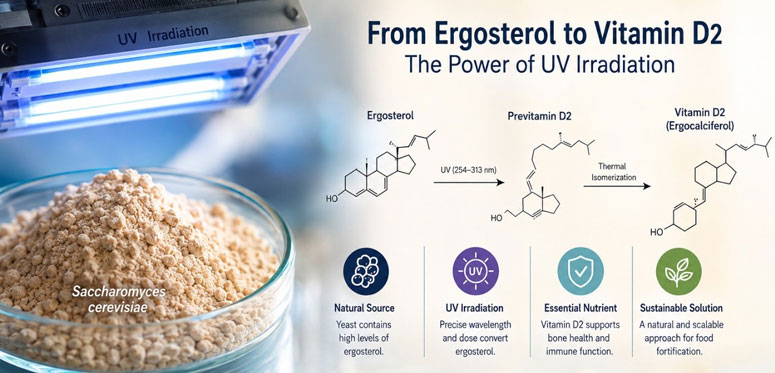
One of the most promising approaches is using the yeast Saccharomyces cerevisiae as a biological platform to produce vitamin D2 (ergocalciferol) through controlled ultraviolet (UV) irradiation.
This yeast naturally contains substantial amounts of ergosterol in its cell membrane a compound that serves as the direct precursor of vitamin D2 and converts to it under UV light of the appropriate wavelength.
This review examines the technical parameters that govern the yield of this photochemical conversion, drawing on findings from credible scientific studies to provide a clear picture of the opportunities and limitations of this technology for industrial application.
Ergosterol: The Key Precursor in Saccharomyces cerevisiae
Ergosterol is the principal membrane sterol in fungi and yeasts, playing a role analogous to cholesterol in animal cells. In Saccharomyces cerevisiae, it can account for the vast majority of the free sterol pool within the cell.
A study conducted in 1978 showed that in control cells without irradiation, ergosterol was the dominant sterol in Saccharomyces cerevisiae. This finding highlights the strong potential of this microorganism as a natural source of vitamin D2 precursor.
In addition to using existing biomass, such as brewer’s yeast, ergosterol content can also be increased by optimizing fermentation conditions. Precise control of dissolved oxygen at around 12%, combined with pulse fed-batch fermentation, has been reported to achieve an ergosterol concentration of approximately 1.16 g/L (2023).
These finding matters because raising the baseline ergosterol content before UV treatment can directly influence the final amount of vitamin D2 that can be produced one of the practical routes to production cost reduction at industrial scale.
The Photochemical Mechanism of Ergosterol Conversion
The conversion of ergosterol to vitamin D2 is a multi-step photochemical reaction. In the first step, UV light of the appropriate wavelength opens the B-ring of the sterol, producing previtamin D2.
Previtamin D2 is an unstable intermediate that gradually rearranges through a thermal isomerization to form vitamin D2. A portion of the previtamin can also convert into byproducts such as lumisterol and tachysterol.
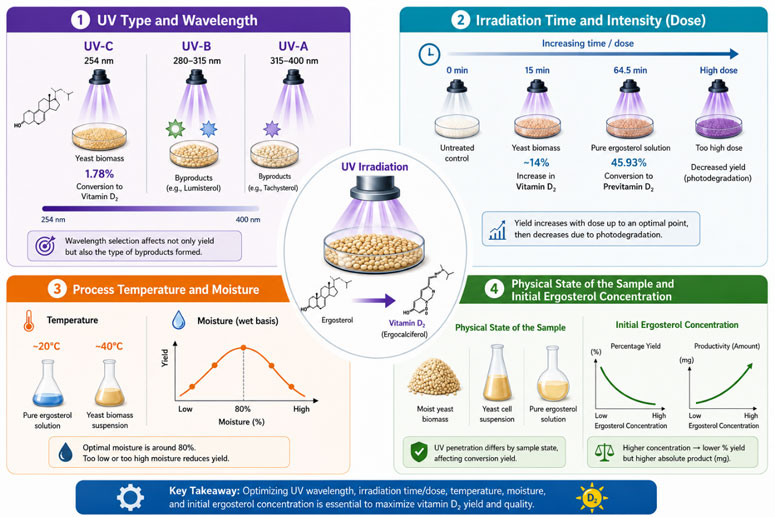
The irradiation wavelength strongly influences which byproduct predominates. For example, shorter wavelengths such as 254 nm (UV-C) tend to favor tachysterol formation, while longer wavelengths in the UV-B range are more associated with lumisterol.
In a study published in 2000, the oxidative pathway of ergosterol by singlet oxygen and the formation of 8-hydroxyergosterol were investigated; however, this route differs from the main vitamin D2 production process and is primarily of research interest.
The final yield of ergosterol-to-vitamin-D2 conversion depends on a set of process parameters that must be carefully controlled. The most important of these, based on research evidence, are reviewed below.
UV Type and Wavelength
Depending on the process goal, UV-A, UV-B, or UV-C ranges may be used. Researchers in 2020 reported that UV-C irradiation at 254 nm applied to brewer’s yeast biomass resulted in an ergosterol-to-vitamin D₂ conversion rate of approximately 1.78%.
A study published in 2007 reported that irradiation of a pure ergosterol solution using a UV source with a primary wavelength of 313 nm, combined with a lead acetate filter to remove wavelengths below 275 nm, significantly enhanced previtamin D₂ formation.
Wavelength selection affects not only yield but also the type of byproducts formed; wavelength optimization must therefore go hand in hand with final product quality control.
Irradiation Time and Intensity (Dose)
Irradiation time is one of the most influential parameters on conversion yield. In a study on Saccharomyces cerevisiae biomass, 15 minutes of UV-C irradiation increased vitamin D2 content by roughly 14% relative to the untreated control.
The researchers of that study suggested that longer irradiation times could further increase vitamin D2 content in yeast, although this hypothesis requires further experimental verification.
In another study on a pure ergosterol solution, the optimal irradiation time was determined to be 64.5 minutes, at which the actual conversion yield to previtamin D2 averaged 45.93%.
Won et al. (2017) demonstrated using response surface methodology (RSM) that UV dose was the most influential factor affecting vitamin D₂ production. Increasing the dose up to an optimum level enhanced vitamin D₂ formation, whereas excessive doses reduced yield because of photodegradation.
Process Temperature and Moisture
Temperature is another critical parameter affecting conversion yield. The 2007 study reported an optimal temperature of approximately 20°C for pure ergosterol solutions, whereas Won et al. (2017) reported an optimal temperature of approximately 40°C for UV-treated mushrooms.
This difference shows that the optimal temperature depends on the type of substrate pure solution versus complex biological tissue and cannot be generalized as a single fixed value across systems.
Sample moisture also matters for solid biological substrates. In a response-surface-methodology study, the optimal sample moisture was found to be around 80% (wet basis), with yield decreasing at both excessively high and low moisture levels.
Physical State of the Sample and Initial Ergosterol Concentration
The physical state of the sample whether moist yeast biomass, cell suspension, or a pure ergosterol solution in solvent affects UV penetration and therefore the final yield.
In pure ergosterol solutions, initial concentration is also a key parameter. Findings show that as initial ergosterol concentration increases, the percentage conversion yield decreases, while overall productivity (the absolute amount of product formed) increases.
This is important for industrial decision-making, since the optimal concentration should be chosen based on the process goal maximizing percentage yield or maximizing absolute product output.
Comparing Conversion Yields Across Different Substrates
A review of available data shows that the conversion yield of ergosterol to vitamin D2 depends heavily on substrate type. In pure ergosterol solution, conversion to previtamin D2 can reach around 46%.
By contrast, in Saccharomyces cerevisiae biomass with its more complex cellular matrix the conversion rate of ergosterol to vitamin D2 was reported at only 1.78% in one experiment, indicating that the biological matrix can hinder full UV penetration to all ergosterol molecules.
This gap between pure-solution yield and whole-biomass yield represents one of the central food industry challenges in commercializing this technology, and calls for process engineering solutions to improve light penetration.
Quality and Safety Challenges in Industrial Production
Research published in 2024 reported that the measured vitamin D₂ content of all commercial yeast-based supplements analyzed differed from the declared label values, with several products falling outside the acceptable tolerance range established by the European Union.
This highlights the importance of rigorous quality control during production, as well as the use of validated analytical methods such as high-performance liquid chromatography (HPLC).
From a safety standpoint, assessments by credible international bodies such as the scientific opinion published by the European Food Safety Authority (EFSA) in 2014 on vitamin D-enriched, UV-treated baker’s yeast have established the scientific basis needed for the safe use of this type of yeast in food products.
Such safety frameworks play an important role in facilitating funding for food startups, since venture capital funds and food accelerators typically evaluate a technology’s safety and regulatory track record before backing innovative food industry ideas.
Future Outlook and Optimization Strategies
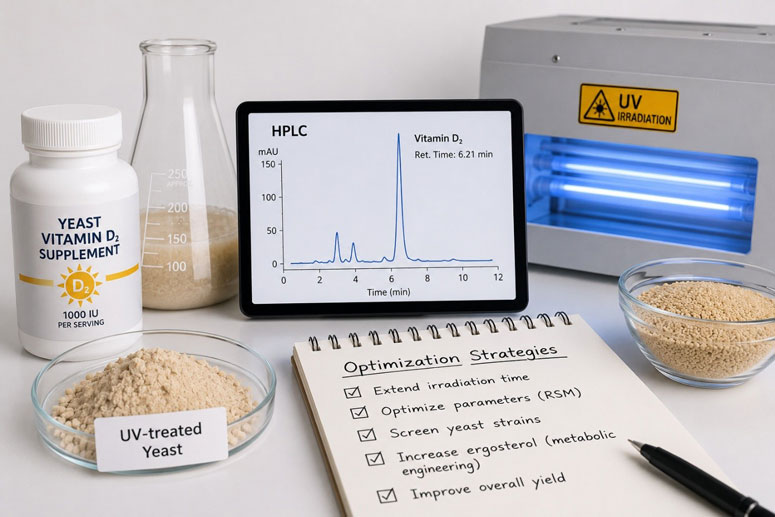
Given the relatively low conversion yield in whole yeast biomass compared to pure solution, researchers have proposed strategies such as extending irradiation time, simultaneously optimizing multiple parameters through response surface methodology (RSM), and screening yeast strains with higher baseline ergosterol content.
In parallel, metabolic engineering of industrial Saccharomyces cerevisiae strains to increase ergosterol accumulation in the cell membrane before UV treatment could provide a complementary route to improving overall process yield.
For any food industry startup entering this space, combining biological optimization (raising intracellular ergosterol) with process optimization (wavelength, dose, temperature, and moisture) will be key to achieving a competitive, economically viable product.
Ultimately, advancing this technology could position UV-treated yeast as an innovative food industry idea a natural, sustainable alternative to current vitamin D sources and help address vitamin D deficiency at the population level.
Conclusion
Saccharomyces cerevisiae, owing to its naturally high ergosterol content, is considered one of the most promising biological sources for vitamin D₂ production. The conversion of ergosterol to vitamin D₂ through UV irradiation is a relatively simple process; however, it is highly sensitive to operating conditions.
Published studies indicate that UV wavelength, irradiation dose, exposure time, temperature, moisture content, the physical state of the sample, and the initial ergosterol concentration are the key factors influencing conversion efficiency. Among these parameters, irradiation dose and wavelength have the greatest impact on vitamin D₂ yield, making their precise control essential to maximize conversion while minimizing the formation of undesirable photoproducts and photodegradation.
Although the conversion efficiency of purified ergosterol solutions can be relatively high, the efficiency decreases substantially in intact yeast biomass because the cellular matrix limits UV penetration. Consequently, future research should focus on improving photoreactor design, optimizing process parameters, and increasing intracellular ergosterol levels prior to UV treatment in order to enhance the overall efficiency of vitamin D₂ production.
With the growing demand for sustainable, non-animal sources of vitamin D, UV-treated Saccharomyces cerevisiae has significant potential for applications in the food industry, dietary supplements, and fortified foods, offering a promising strategy to help address the global prevalence of vitamin D deficiency.
Frequently Asked Questions
1. What is vitamin D2 and how does it differ from vitamin D3?
Vitamin D2 (ergocalciferol) is a plant- and fungus-derived form of vitamin D, produced from a precursor called ergosterol under UV irradiation, whereas vitamin D3 (cholecalciferol) is mainly of animal origin. Both forms are converted to the active vitamin D metabolite in the body, though some studies report differences in their relative efficacy.
2. Why is Saccharomyces cerevisiae used to produce vitamin D2?
This yeast naturally contains high levels of ergosterol in its cell membrane, has a long history of safe use in the food industry, and its industrial-scale production through fermentation is well established.
3. Which parameter has the greatest effect on conversion yield?
Across different studies, UV dose (a combination of intensity and time) and irradiation wavelength are among the most influential parameters, though temperature and sample moisture also play a significant role in solid biological substrates.
4. Can UV irradiation of yeast create undesirable side effects?
Yes, irradiation at an inappropriate wavelength or dose can lead to byproducts such as lumisterol or tachysterol, and excessively high doses can cause photodegradation that reduces vitamin D2 yield. Careful control of process parameters is essential to minimize these effects.
5. Is using vitamin D2-enriched yeast in food products safe?
Based on assessments by credible bodies such as the European Food Safety Authority, UV-irradiated, vitamin D-enriched baker’s yeast has been evaluated as safe for use in food products under controlled conditions and within permitted limits.
