
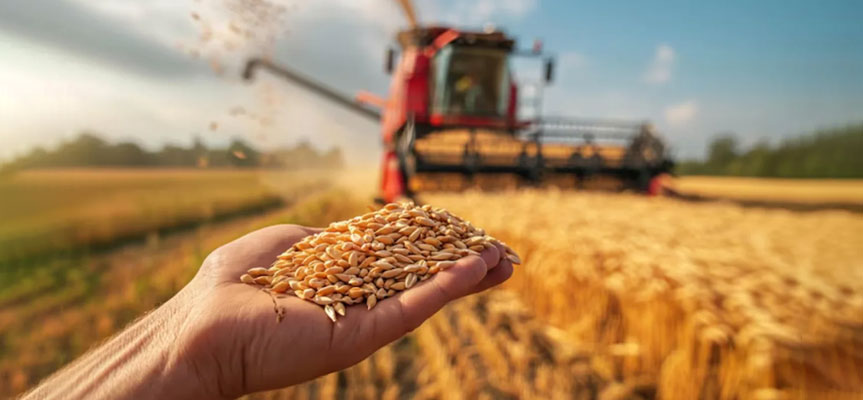
Traditional wheat farming in Iran has faced serious challenges over the past decades from diminishing water resources to declining soil productivity. Amidst these issues, modern wheat farming has emerged as a vital solution for ensuring food security, reducing waste, and increasing profitability. This transformation goes beyond just changing tools; it’s a shift in mindset, approach, and decision-making based on data and technology.
In this article, we explore various aspects of modern wheat farming from advanced tools like drones and drip irrigation to the role of data mining, improved seeds, and farmer education.
A Transformation in Wheat Cultivation: A Look at Modern Agriculture
In modern agriculture, wheat is no longer just a grain to be planted in the soil and watered. Now, data, sensors, forecasts, and precision technologies come into play. Modern farming is a system based on information and intelligent decision-making, designed to increase agricultural productivity and reduce resource consumption.
The Importance of Modern Agriculture in Wheat Production
In a world where natural resources are becoming scarcer and demand for food is increasing, modern agriculture is now a strategic necessity. Wheat, which plays a vital role in food security, must be produced using methods that both protect environmental sustainability and increase yield. Modern farming makes this possible through tools such as:
- Real-time farm monitoring
- Advanced data analysis
- Precision input usage
This innovative farming style not only helps boost quantitative production, but also improves the quality of the final product a key factor in export markets.
Innovative Wheat Cultivation Methods in Iran
In Iran, farmers are gradually shifting toward modern wheat cultivation methods. These approaches combine technology with indigenous knowledge:
- Direct Seeding: Reduces costs, preserves soil structure, and lowers water evaporation.
- Combining traditional techniques with advanced machinery: Such as precision seeders and combinator machines.
- Conservation Agriculture: Reduces soil erosion, increases beneficial microorganisms, and retains moisture.
- No-Till Farming: Saves energy and prevents soil degradation.
These methods are highly adaptable to Iran’s diverse climates, especially in provinces like Golestan, Kurdistan, and South Khorasan.

Technology Use in Wheat Farming
Modern technologies are now involved in every stage of planting, cultivation, and harvesting:
- Drones for monitoring crop health and detecting pests
- Soil and moisture sensors for precision irrigation management
- Satellite systems for climate condition forecasting
- Farm management software for precise control of costs and performance
Smart Irrigation Systems for Wheat
In a country like Iran, where water stress is severe, smart irrigation systems are critical for sustainable wheat production. These systems automatically adjust irrigation schedules based on data from soil moisture sensors, climate conditions, soil types, and plant growth stages.
Key features of these systems include:
- Zone-based irrigation: Each section of the farm is watered based on its specific needs.
- Internet of Things (IoT) integration: Remote system control via mobile phone or computer
- Up to 50% water savings and improved wheat grain quality
In pilot projects implemented in Isfahan and Kerman, the efficiency of these systems has resulted in water use doubling in effectiveness.
The Role of Drones in Modern Wheat Farming
Drones are not just cool gadgets they are the intelligent eyes of modern farmers. In wheat cultivation, they have revolutionized field monitoring, assessment, and management.
Specialized applications of drones in this field include:
- High-resolution topographic mapping of fields
- Plant health monitoring using thermal and multispectral cameras
- Precise identification of nutrient deficiencies or pest infestations
- Targeted spraying of pesticides or fertilizers in specific doses
Drones are particularly useful in large-scale farms or areas with difficult access, providing fast and accurate oversight while reducing operational costs.
Improved Seeds: The Heart of Modern Agriculture
Improved seeds are a cornerstone of modern wheat farming. Their advantages include:
- Greater resistance to drought and heat
- Up to 30% increase in yield
- Reduced need for pesticides and insecticides
The impact of improved seeds on wheat production in Iran is clearly visible in provinces like Razavi Khorasan and Fars, where the adoption of new varieties has significantly increased productivity.

Precision Farming in Wheat Fields
Precision Agriculture is a combination of technology, data science, and zonal farm management that enables farmers to apply inputs with millimeter-level accuracy.
In wheat farms, this approach includes:
- Variable Rate Technology (VRT) for fertilization and irrigation
- GPS and GIS systems to pinpoint each area’s exact location
- Monitoring plant growth through sensors and satellite imagery
These practices result in higher yields, lower costs, and more uniform, high-quality crops exactly what global markets demand.
Best Wheat Cultivation Practices in Iran
Successful methods of wheat cultivation in Iran often stem from a combination of traditional experience from local farmers and new scientific strategies. Some of these methods include:
- Using drought- and salinity-resistant wheat varieties
- Optimizing planting time based on regional climatology
- Proper soil aeration through shallow tillage or no-till farming
- Applying organic fertilizers instead of chemical ones to enhance soil biology
- Utilizing early warning systems for pests and diseases
These methods not only lead to increased yields but also preserve environmental sustainability.
Data-Driven Productivity in Agriculture
One of the key features of modern wheat farming is data-based decision-making, such as:
- Monitoring temperature, humidity, and light levels precisely
- Analyzing crop performance in different areas
- Planning irrigation and fertilization with predictive algorithms
The Role of Data Mining in Wheat Farming
Data mining in agriculture refers to extracting hidden patterns from large volumes of agricultural data. In wheat cultivation, this technology helps with:
- Analyzing historical yield data to forecast annual production
- Predicting disease outbreaks and the need for preventive action
- Evaluating the cost-benefit of different farming methods across regions
- Personalizing irrigation and fertilization recommendations for each farmer
With access to reliable data, data mining can transform wheat agriculture into a model of “futuristic farming.”

Educating Farmers in Modern Agriculture
Changing farmers’ mindsets requires continuous education. Training programs are delivered through:
- Simple mobile phone applications
- Local social media platforms
- On-site workshops and field trials
Grownida ’s Role in Advancing Modern Agriculture
The Grownida Innovation and Creativity Center is a key player in modernizing Iranian agriculture, particularly in the wheat sector. Grownida acts not just as a tech-based institution, but also as a smart facilitator bridging the gap between traditional and digital agriculture. Some of its key initiatives include:
- Data-driven farmer education
- Collaborations with national academic and executive bodies
- Farm performance analysis and data mining
- Offering expert consulting services
Overall, Grownida serves as a catalyst that accelerates the transition from traditional to future-focused farming. With the continuation of this path, modern wheat agriculture in Iran could become a regional model in the Middle East.
Challenges and Opportunities in Implementing Modern Agriculture
Challenges:
- Lack of proper training for traditional farmers on new technologies
- Infrastructure issues like poor internet in rural areas
- High initial costs of acquiring modern equipment
- Cultural resistance to change and innovation
Opportunities:
- Access to government support and rural development loans
- Rising wheat prices and export potential
- Growing involvement of startups and innovation centers like Grownida
- Synergy between local technologies and global knowledge
If pursued correctly, modern wheat agriculture in Iran can be both indigenous and competitive on the international stage.

The Future of Modern Wheat Agriculture in Iran
The envisioned future for wheat farming in Iran is smart, data-driven, and sustainable. The emergence of educated young farmers, investments from specialized startups, and supportive policies will accelerate this progress. In this future:
- Data is analyzed in real-time
- Decisions are made automatically and intelligently
- Every farm becomes a digital ecosystem
Brands like Grownida combining innovation, research, and pragmatism—can form the backbone of this sweeping transformation.
Conclusion
Modern wheat agriculture is a fusion of science, technology, and experience. This new model not only improves productivity but also provides a solution for resource conservation and sustainable development. Leveraging technology, optimized seeds, and data mining can place Iran on the path to wheat self-sufficiency and profitability.
Whether you’re a farmer, investor, or researcher now is the time to join the movement of modern wheat farming and step boldly into innovation.
Frequently Asked Questions
What is modern wheat agriculture?
It’s a model of wheat cultivation that increases productivity using modern technologies such as data mining, sensors, and genetically improved seeds.
Why is modern agriculture important for wheat production?
Because it boosts yield, reduces resource consumption, and promotes sustainable agriculture.
How can wheat yield be increased?
By using improved seeds, smart irrigation systems, drone-based field monitoring, and data analysis.
What tools are used in modern wheat agriculture?
Drones, soil sensors, farm management software, smart irrigation systems, and predictive algorithms.
What are the benefits of genetically improved wheat seeds?
Higher yield, greater drought resistance, and reduced need for pesticides.
